
….applauds revenue team, Ekiti people
By Demola Atobaba, Ado-Ekiti
Executive Chairman of the Ekiti State Internal Revenue Service (EKIRS), Mr. Olaniran Olatona, has said that his team is not in any way ready to introduce any new tax policy, but will maintain a cordial relationship with the good people of Ekiti State.

The revenue Boss appealed to small scale business owners in the state to show understanding over the agency’s recent tax assessments issued to operators in the informal sector
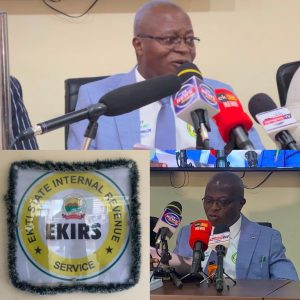
Speaking with newsmen at the Revenue House Headquarters on Thursday in Ado-Ekiti during a media chat, Olatona explained that the documents are lawful notices and not an enforcement order as speculated in some quarters, adding that every operator has the right to object and seek a review which he said the service would gladly attend to them.
He explained that the notices served on traders, artisans and other informal sector operators relate mainly to outstanding tax liabilities for the 2024 and 2025 tax years and are in line with the provisions of the Nigerian Tax Act 2025.

According to him, the recent protests and social media campaigns against the assessments were unnecessary because the law already provides taxpayers with avenues to challenge any assessment they consider excessive.
Olatona explained that the service is more interested in the business growth of the people and is not ready to inflict pains and difficulties on anyone saying their business success guarantees the existence of the service.

“Assessment is not the same thing as enforcement. If a taxpayer is not comfortable with the tax liability contained in the notice of assessment, there is a lawful stipulated way to seek a review.”
He explained that taxpayers have 30 days to file a written objection, stating the grounds for disputing the assessment and providing supporting evidence, after which EKIRS is required to review the objection and respond within 90 days.
The chairman noted that the service often goes beyond the legal requirements by entertaining objections even when taxpayers fail to provide detailed grounds as stipulated by law.
“We still invite them for discussions, review their records and even reduce assessments where the evidence supports their claims,” he said.
Olatona cited instances where assessments were reviewed downward after inspections revealed lower business activity than initially estimated, including the case of a private school and a hospital whose tax liabilities were reduced following verification.
The EKIRS chairman argued that contrary to public perception, the informal sector contributes only a small fraction of the state’s internally generated revenue (IGR).
He disclosed that direct assessment on self-employed persons generated about ₦1.23 billion in 2025, accounting for roughly 4.5 per cent of the state’s ₦27 billion IGR.
When combined with collections from markets, commercial transport operators, business premises registration and other informal sector levies, the total contribution stood at about ₦1.46 billion.
By comparison, he said, Pay-As-You-Earn (PAYE) taxes account for approximately 63 per cent of the state’s revenue.
He added that direct assessment collections have actually been declining, dropping from about ₦161.9 million in January 2026 to ₦76.1 million in June 2026, demonstrating that the informal sector is not the primary driver of state revenue.
Olatona attributed complaints about higher tax bills to improvements in EKIRS’ data systems rather than new tax rates.
He explained that under previous manual processes, tax officials had limited information about taxpayers’ businesses stressing that digital integration and enhanced access to taxpayer data now enable the service to identify multiple businesses owned by the same individual and assess tax liabilities more accurately.
“Many people say they paid ₦80,000 last year and are now being asked to pay ₦180,000, it is because we now have more comprehensive data than before.”
He added that many taxpayers who visit EKIRS for clarification eventually accept the assessments after reviewing the evidence.
The chairman also revealed that EKIRS deliberately suspended active tax enforcement from July 8, 2025, to test whether improved tax administration and voluntary compliance could sustain revenue growth under the new tax regime.
Despite the suspension, he said, the state’s IGR continued to rise, demonstrating that compliance, not coercion, is driving revenue performance.
He maintained that the agency has shifted its focus to automation, taxpayer education, digital payment platforms and improved data analytics rather than sealing business premises or deploying enforcement teams.
While acknowledging public concerns, Olatona urged taxpayers to engage with EKIRS instead of resorting to protests or social media campaigns.
He also expressed appreciation to traditional rulers, particularly the Ewi of Ado-Ekiti, for helping to calm tensions during the recent controversy and facilitating dialogue between EKIRS and protesting groups.
According to him, many issues were resolved after tax officials met with representatives of the affected groups and explained the basis for the assessments.
“The law provides several layers of review and even avenues for appeal. We are more interested in helping businesses grow than in bringing them down because a thriving business benefits both the taxpayer and the state,” he stated.