
….Vows to create million jobs, free healthcare, education
- By Demola Atobaba, Ado-Ekiti
As the 2027 presidential election start gathering momentum, members of the Peoples Democratic Party (PDP) in Ekiti state has wowed to take the bull by the horn come next year.
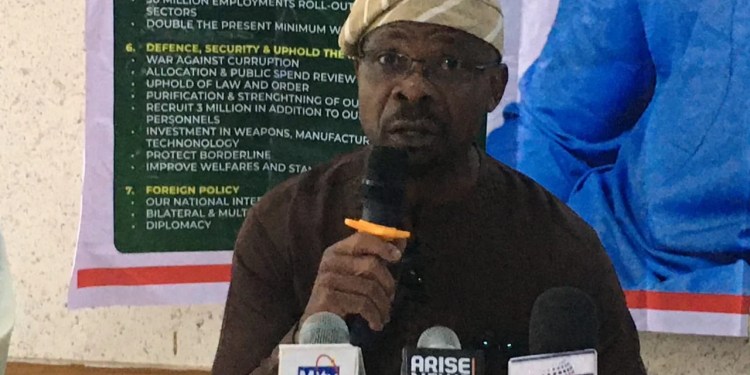
Speaking at a press briefing in Ado-Ekiti on Tuesday, a presidential aspirant under PDP, Surveyor Victor Femi Ekunyan disclosed his team 7-points agenda for Nigeria, declaring he has been ordained to rescue Nigeria from the present challenges.

The Ise-Ekiti in Ise/Orin Local Government born politician describes himself as “a common Nigerian, very unknown name, from a very unknown town,” offering both sweeping policy promises and a personal profile that breaks sharply from traditional political pedigrees.
While hinted his 7-point agenda, Ekunyan highlighted job creation and Agriculture, free healthcare, free education, infrastructure development, electricity and industrial policy, defence, security, and anti-corruption and foreign policy, pledging 20 million jobs for Nigerians if elected president.
Later in the briefing, he revised the figure upward, stating his administration would “roll out 30 million employment” plus an additional 3 million for security agencies, totaling 33 million jobs.
He tied the bulk of job creation to a national agriculture and agri-food program, which he said would “surpass the oil we are producing today” and “flood Nigeria with abundance of food.” He set a proposed minimum wage of ₦150,000 for jobs created under this agenda.
On health, Ekunyan promised completely free healthcare for all citizens. Acknowledging the strain this would place on the system, he pledged to double the number of health workers, invest heavily in medical equipment, renovate existing hospitals, and build new hospitals and “temporary clinics” to handle increased traffic.
He also committed to create a national health sector database “to enable us have a good track record.”
Ekunyan vowed to make education free across primary, secondary, and tertiary institutions, with school fees abolished. He said school attendance would be compulsory for every child. His education plan includes building new schools and prioritizing teacher’s welfare.
The fourth pillar focuses on physical infrastructure. Ekunyan promised to create inter-state road networks to link the country and drive the economy. He also announced plans for new railway stations across Nigeria, arguing that the absence of a “national infrastructure” and “national agenda” has left states pursuing disjointed projects.
Describing Nigeria’s electricity problems as “huge,” Ekunyan said he would install high-capacity strong cables nationwide to ensure broadband access for everyone.
He tied this to broader economic plans, including attracting foreign investment, stabilizing the economy, and giving support to local manufacturers and local production of goods and services.
Putting current security staffing at “about 500,000 professional security agencies to secure 250 million people,” which he called “practically impossible,” Ekunyan promised to build defence complex where weapons would be manufactured in large quantities in the Country.
On insurgency, he made a striking promise to end the menace in the Country.
On corruption, he said the war against it would be a key task, starting with a review of public spending and state allocations.
He argued that slashing state allocations would cut off opportunities to loot. He also described the judiciary as “very shaky” with Nigerians no longer trusting it, and promised to “beautify the country’s judicial system.”
Ekunyan stated his foreign policy would put “the country’s national interest first above all.”
Pressed repeatedly on the cost of free healthcare, free education, and mass job creation, Ekunyan insisted: “We have the cash.” He pointed to two main sources; in his effort to review public spending by slashing the State allocation and increasing public spending on one hand, and on the other hand, focusing on Agriculture Revenue through the Agri-food program which would generate revenue different from the current oil production, he concluded.


