- By Demola Atobaba, Ado-Ekiti
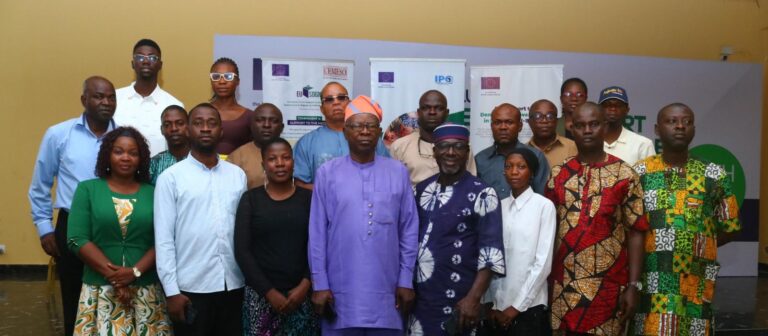
As the June 20 governorship election in Ekiti State nocking at the door, concern stakeholders, the International Press Centre (IPC), in conjunction with the Centre for Media and Society (CEMESO), has equiped journalists in the state on election observation, media safety, digital rights protection and responsible reporting under the European Union-Support to Democratic Governance in Nigeria (EU-SDGN II) programme.
The one-day training, sponsored by the European Union, was organised to prepare journalist-observers for effective coverage and monitoring of the electoral process across the state.
Giving his opening remarks at the event in Ado-Ekiti, the Executive Director of the International Press Centre, Lanre Arogundade, said the programme was designed to strengthen the capacity of journalists to provide credible, timely and comprehensive reports on the conduct of the election.

According to him, reports gathered from journalists deployed across the state would form part of a broader election assessment framework to evaluate the conduct of the poll.
Arogundade explained that the organisation would issue a preliminary report on election day, followed by a more detailed and comprehensive assessment after the exercise.
He noted that the deployment strategy would ensure wide coverage across local government areas in the state, stressing that the media remained critical to ensuring transparency and accountability during elections.
The IPC boss further said the training focused not only on the physical safety of journalists but also on the growing challenges associated with digital journalism and online reporting.
His words: “What we are going to do is review the reports that we get from you as journalists and planners to enable us to read that larger report for the conduct of the election.
“We’ll have our first report for the day of the election in the afternoon meeting. That will be a preliminary report. And then later on, there will be a more comprehensive. At this time, I had to work with the international system to work over all the local government, civil government affairs, which means that we will be deploying at least 2% of our local government.
“And of course, the tool that we’re going to use for this will form the later part of the program. And why is this so important? Because without the media reporting the processes freely and without any problem, we will not be able to get live information about how the network will go on two days. We will take a lot of premium on our own. Some of the details will go to the quality of the funding.
“We are not just looking at the fiscal aspects, we are also looking at the digital aspects. For the fiscal aspects, we are trying to be as effective as possible for the police, the case, the harassment and so on.
“Your relationship with any of these parties, whether they’re agents or legal forces that come out of the country. So those would be some of our two goals and areas. But I also expect two others, who have learned a lot and work on the grassroots message so that we can move towards the grassroots message”.
On his part, CEMESO Executive Director Dr. Akin Akingbulu said the workshop would address potential attacks journalists may face in the field on election day, and outline measures to prevent or reduce such risks.
He urged reporters covering the election to remain vigilant and report any abuse of journalists.
During the technical sessions, CEMESO Programme Manager, Timothy Bamidele and IPC Project Manager Sanmi Falobi introduced participants to technology applications designed to support observers on election day.
The event also refreshed participants on the purpose of election monitoring, with emphasis on the differences and similarities between misinformation, disinformation and hate speech.